The interactive deck is designed for a larger screen. For the smoothest experience, please revisit on desktop, or download the PDF below.
Download PDF
Every legal AI on the market asks a probabilistic model to hold the state of a live matter — every term, threshold, election and side-letter concession in flux across months, with consequences cascading into years down the line. A context window is the wrong tool for holding state. State needs a substrate to live in; a context window isn't one. The three problems below are symptoms of asking a reasoning layer to behave like an authoritative matter record.
Dig for the right document, attach it, prompt engineer, pray the context window holds, wait for a conversational answer, repackage that answer into something actually usable. That is not a sustainable workflow — it is a workaround in the absence of anything better.
Posing deterministic questions to probabilistic models is senseless: you pay for tokens and wait for half-hours to play "Where's Waldo?". Even at 99.9% accuracy, if you don't know where the 0.1% is, all 100% must be checked. That is a fundamental limitation of vector indexing, especially when applied to large volumes of unstructured data.
By the time a probabilistic model finishes burning tokens on what should've been deterministic all along, it's run out of context window to do the real work that requires nuanced judgment. This is why practitioners know that currently available products cannot deliver redlines or insights to the level of a junior associate.
The jury is filing back into court and the verdict has been reached: Kirkland & Ellis is investing $500m into building custom tooling in-house. Freshfields is building directly with Anthropic. Although there are only a handful of firms globally that have the revenue to justify this spend, these market signals point strongly in the same direction: that currently available solutions are simply not deep enough into the vertical to create genuinely usable outputs for practice area specialists who do this work day in, day out. As the elite powerhouse firms with generous innovation budgets are racing to build from scratch and the mid-market firms feel forced to buy generic tooling dressed as "vertical" off-the-shelf, we've been quietly building a third way that serves both buyer personas.
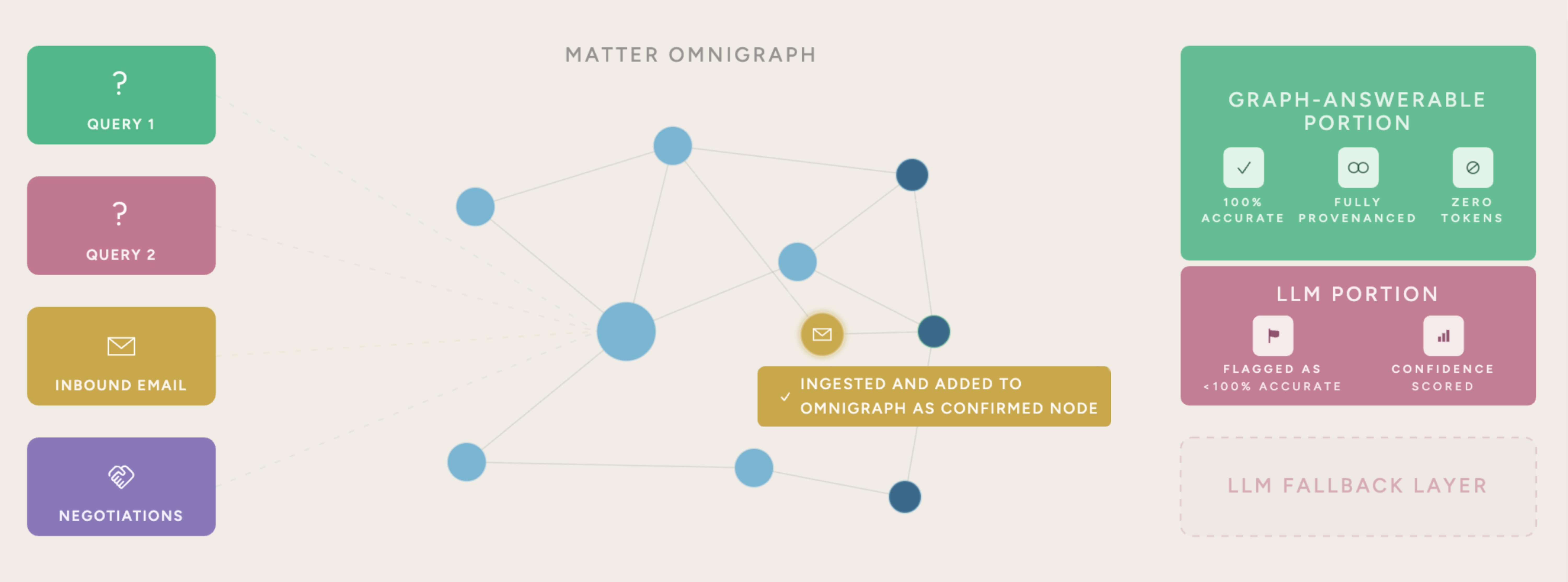
Matrix gives the legal AI stack a live, permissioned matter-state layer. Firms keep the AI interfaces lawyers already use — Harvey, Legora, OpenAI, Claude and internal agents — while Matrix becomes the authoritative graph those tools call before they reason, draft, compare, escalate or act.
The Omnigraph resolves known facts deterministically, with source, permission, version and decision lineage attached. Only the remainder routes to the probabilistic model layer, bounded by current matter context instead of loose documents. MCP makes the connector lightweight; the product depth lives in deterministic state, permissioned retrieval and reusable matter context.
Scan to see the Omnigraph animation in your browser — best on desktop.
We enter where firms already have approved AI interfaces. The same Matter Omnigraph architecture then compounds into workflow execution, and ultimately into firm memory no model or point solution can recreate.
Answers, workflows and firm memory all call on the same immutable record.
Source trails are attached from ingestion, not reconstructed later.
Matter data stays sealed, region-hosted and scoped per user.
Retrieval becomes workflow execution, then institutional memory.
The same schema unlocks client and practice-area insight.
The legal AI budget has already been unlocked by horizontal reasoning platforms. That is not a threat to Matrix; it is the insertion point. As firms standardise on approved AI interfaces, agents need a deterministic context infrastructure layer underneath them: live matter state, permissions, provenance and auditability before they draft, compare, escalate or act.
Every workaround on the left exists because no one owns matter state. Matrix is not another layer on the stack; it is the ground the stack stands on: auditable, permissioned, workflow-embedded, and purpose-built for transactional practice.
Broad productivity and reasoning, sold practice-wide. Powerful distribution, but no record of what has actually been agreed in the matter.
Agentic workflows surface complex relationships; they still need a liability-grade deterministic layer for agents to query.
Reasoning keeps improving. Domain state does not appear by magic. Build the substrate yourself, or call Matrix.
MCP gives Matrix a lightweight insertion point. Distribution first, substrate ownership second, workflow expansion third.
The wedge is intentionally thin: plug into Harvey, Legora, Claude, OpenAI and firm-built agents as the matter-state and provenance layer. The moat compounds as each deployment creates reusable transaction memory, workflow precedent and benchmark intelligence. MCP is the connector; the durable asset is the graph, audit trail, ontology and cross-matter memory.
Matrix sits next to DMS, billing, email and deal-room systems, so it captures live matter state rather than static prompts or copied documents.
Every answer can carry source, permission, version and decision lineage. That makes the layer useful for risk, privilege and client accountability.
One firm-controlled layer normalises the messy context that models need: who can see what, what changed, which precedent matters, and where the deal actually stands.
entities, documents, clauses, people and obligations linked to each matter.
tasks, approvals, status, deadlines and handoffs captured as work happens.
permissions, provenance, audit trails and client-specific guardrails enforced before retrieval.
Each transaction teaches playbooks, approval paths and exception patterns. The product gets better at how the firm actually executes.
MCP makes Matrix callable from the tools firms already adopt. When models churn, the context, ontology and trust layer stay.
Proof object: distribution-first trust infrastructure. The connector gets us called; each deployment leaves behind transaction memory, permission logic and benchmarkable matter intelligence.
Value-based (per-matter) pricing, not per-seat. Blended ~1% take-rate on every mandate onboarded onto Matrix.
Cross-sell to the
counterparty universe within
each multilateral practice
area.
High fan-out potential:
fund formation (many LPs), project
finance (sponsor + lender syndicate +
ECAs + gov + contractors), restructuring
(multi-creditor), syndicated/LevFin.
Medium:
capital markets, real-estate JVs.
Low:
bilateral M&A and real estate.
Market intelligence & benchmarking as a standalone offering • blended ~£50k per subscription. LPs, GPs, banks & corporates already spending on PitchBook, Preqin and Bloomberg terminals.
Build the substrate, and it doesn't just collapse the point-solution sprawl — it throws off value the sprawl never could. The same Omnigraph that wins the core deal spins off four more, each pulled into existence by a market force already in motion.
Harvey shipped agents March 2026; Legora is leaning heavily on their "aOS". Agents need a deterministic layer to query — or they're just ticking liability time-bombs.
Firms get agent-ready infrastructure as a byproduct of the core product — and every agent vendor becomes a tenant of the graph, not a rival to it. MCP makes that context layer callable from the AI front doors firms already bought.
Legal-AI spend is compounding ~28% a year — but it's scattered across ten overlapping point tools that don't hold. Buyers are done paying for patches; they want one thing that works, and rightly so.
GitHub for lawyers, matter tracker, AI-assisted predictive drafting, agentic onward actions, market-wide Thomson Reuters fine-grained for each practice area, firm-wide negotiation analytics, or precedent library... we happen to be all of the above. We bank the budget firms were fragmenting across patches — the good reasoning tools still plug in; narrow patches and point-solutions won't survive the consolidation.
The SRA already holds 200,000 E&W solicitors to a duty of competence, and "the model hallucinated and we don't know how" is no defence to a negligence claim or referral. The EU AI Act adds pressure (fines to €15M / 3%) — though its high-risk obligations, proposed for 2 Aug 2026, may slip to Dec 2027 and aren't settled.
Append-only and immutable, the Omnigraph is the audit trail: every fact permanent and sourced the moment it's ingested and confirmed. The sooner a firm adopts, the longer the period covered by the auditable trail. Nothing to rebuild, no plugin burning tokens poring over reams of conversation history to certify itself five years later.
Under the billable hour, working faster just means billing less — efficiency is a pay cut. Announcing its $500m in-house platform, Kirkland's chair framed it as a shift off the billable hour toward value-based pricing — the top-grossing firm making our case.
Matrix is projected to compress time-per-matter 40-60%; firms bank it as margin instead of writing it off. Labour arbitrage becomes software economics.
Two BAME, female, socially mobile lawyers. One bedroom startup founded 7 years ago that became the multi-award-winning social mobility charity, STRIVE Talent. Now building the intelligence layer that transactional lawyers have needed for decades. Between them: the transactional legal experience and the technical vision to build what nobody else has thought to build in quite this way.

Six years in practice at top fund practices in the City; formation of funds with AUM in the billions is her bread and butter. She has done, manually, everything Matrix is built to replace. Sana does not have a theory about how transactional lawyers work: she is one. She has sat in every closing, negotiated every side letter, and managed every MFN process that Matrix handles. When she says the current workflow is broken, she means she lived it — just last Thursday. She is the domain expert on call who shapes design and schema decisions, tightening the feedback loop from months to minutes.

Chancery-trained barrister. Silver-circle trained solicitor. 42-trained software engineer with systems/architecture depth and product/design instinct. She has acted for Deutsche Bank, Goldman Sachs and Barclays on transactions up to £350M, then as Chief of Staff at a fast-scaling professional services firm drove 40% revenue growth while digitising its entire client base. Her capability as a high-resolution translator between Sana's domain expertise and her varied skills stack means we can execute at breakneck velocity, with crystal clarity of vision, and stay leaner for longer.
~18-month runway — we raise the seed at ~M12 from a position of strength, not necessity. Cash covers the full plan; the raise is a choice, with ~6 months of cushion behind it.
Graph schema, MCP connectors and UI across the 3 launch practice areas. Lead Engineer (secured) plus additional engineering, working alongside fund finance, LevFin and M&A domain experts. Cloud, Neo4j and LLM inference. MVP → v2.0.
The infosec stack institutional firms must see before they sign — SOC2 Type I → II, ISO 27001. Professional indemnity & cyber insurance, legal, finance, and contingency.Salaries sit within the functions above — this line is pure overhead.
GTM Lead hire plus the founder-led partner motion. Design partners converted to 12 paying anchor firms. Conference circuit and category-creation thought leadership.
Built with design partners and live pilots from month one — not in isolation. Product, GTM, team and infosec run in parallel to first revenue, 12 anchor customers, £3.2m ARR and SOC2 Type II. The pre-seed funds the full 18-month plan; we open the Series Seed at ~M12, from a de-risked position.
*Parallel across all three practices targeted for launch: fund formation, finance (fund finance and LevFin), and M&A. • Design partners and pilots run from M1 — the raise funds product, commercial motion and infosec in parallel, not a build in isolation.
We don't — they're competing with each other. We're the trusted matter-state layer their agents eventually need to call into.
~50 AmLaw 100 + 400+ mid-sized + ~550 smaller/regional
Plus ~500+ in-house corporate teams — separate count
Firm-wide productivity layer. Sold per seat across every practice — contract review, drafting, research, due diligence.
50 markets • firm/in-house mix not publicly broken out
Named BigLaw: White & Case, Linklaters, Cleary, Goodwin
Agentic workflows on top of foundation models. Per-seat. Wide coverage of legal tasks, shallow per workflow.
Enterprise tier • top 100 by revenue + Magic Circle
+ boutique + regional firms with transactional deal flow
Workflow-critical depth inside specific transactional practices. Per-matter, value-based pricing — tiered by deal size, ACV-capped per firm — sold into the transactional practice group, not the firm-wide AI budget. Adopted alongside Harvey/Legora, not instead.
The universe of target commercial law firms — top 100 firms by revenue globally — totals roughly ~120 firms. Harvey and Legora's 1,000+ counts inflate via mid-sized firms (Harvey: 400+) and in-house teams; their actual enterprise base sits closer to 50–100 firms each. Matrix's Y3 target of rollout across 70 client firms is a meaningful share representing the transactional-heavy segment of this finite, well-defined market — plus selective boutique + regional firms with transactional deal flow, counted on a separate line and additive to the 70.
†Counting methodology not publicly disclosed. Working assumption: at BigLaw firms, office budgets are set locally, not centrally — even when enterprise licensing is centralised firm-wide. The 1,000+ headline likely registers each office as a separate customer; one firm with offices in London, New York and Singapore reads as three. The most plausible reconciliation against a finite global BigLaw universe.
1Harvey, "Helping Law Firms and Companies Collaborate at Scale," 13 Mar 2026; Harvey, "How Harvey Helps Mid-Sized Law Firms Scale Legal Work," 24 Oct 2025; CNBC, 25 Mar 2026 ($190m ARR, $11B valuation).
2Legora's $100m+ ARR is self-reported (Legora, "…propels Legora past $100M in ARR," 2 Apr 2026); independent reporting put ARR at ~$23m as of Sept 2025 — the basis of the ~240× multiple on the $5.55B Series D (TechFundingNews). Harvey figures are externally corroborated (CNBC).
Isolation enforced at the architecture layer — not just the UI — with role-based access and EU / UK / US data residency. Here is an example diagram of how InfoSec would look for fund formation, but the same principles apply across Finance and M&A.
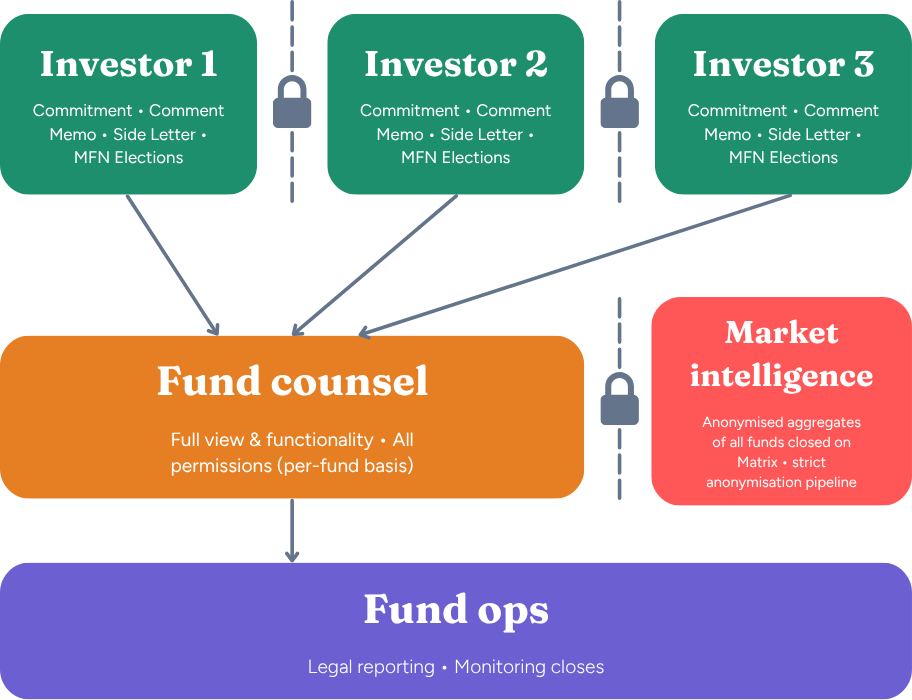
Each investor's side-letter terms, negotiation history and concessions are stored in discrete, permissioned nodes. No investor can query, view, or infer another's position. Confidentiality is enforced at the architecture layer, not just the UI.
Every user operates within a defined permission tier — Fund Counsel (full fund view), Fund Ops (operational data only), Investor Counterparty (own data only). Queries requiring graph traversals beyond each user's permissions will be denied. Access is logged, timestamped and auditable.
Matrix's cloud infrastructure is deployable with EU-based data centres (AWS Frankfurt / Dublin or Azure Netherlands / Ireland) for GDPR-bound funds, UK regions for post-Brexit clients, and US-East / US-West for US clients. Region selection is configured at onboarding and documented in the Data Processing Agreement.